
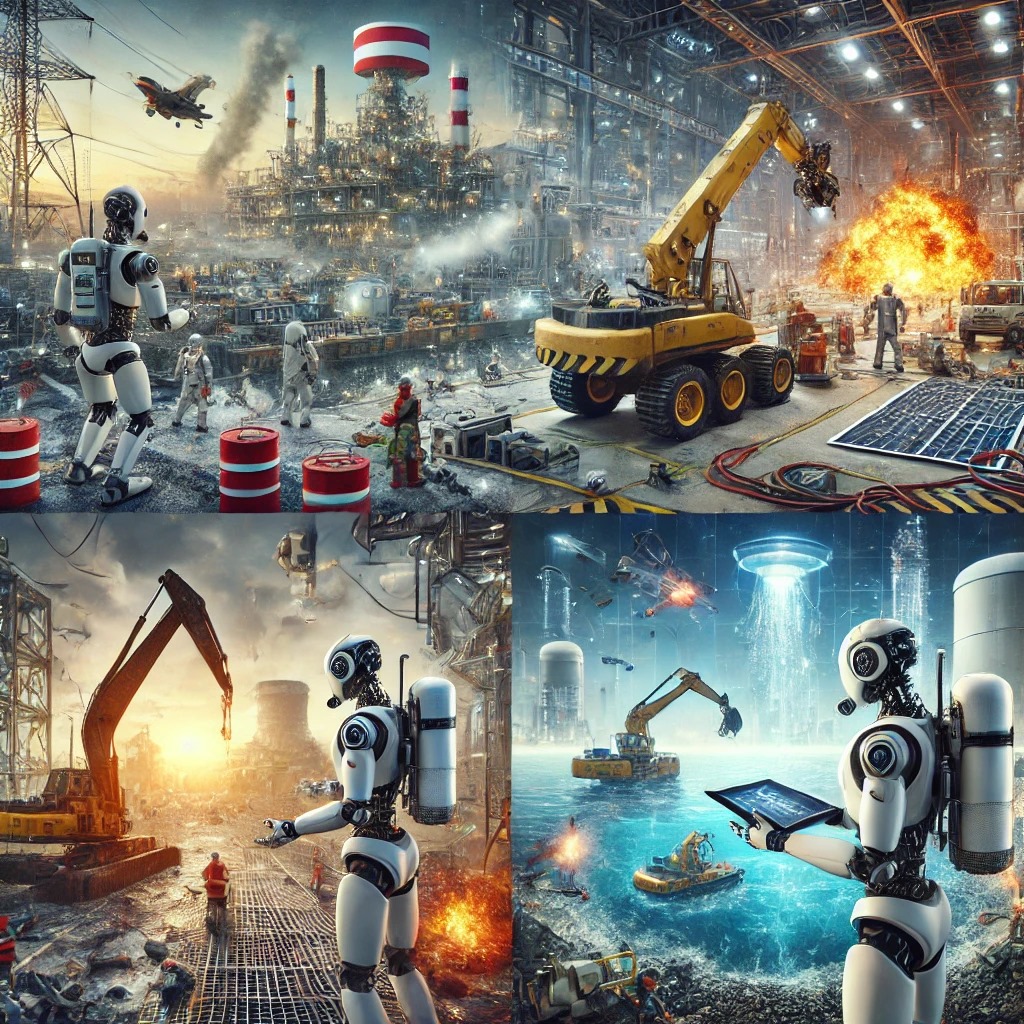
In industries where human safety is a paramount concern, robotics is increasingly playing a critical role in minimizing risks and enhancing efficiency. Hazardous activities, such as disaster response, industrial maintenance, deep-sea exploration, and hazardous material handling, often expose workers to severe dangers. By incorporating robotics into these tasks, organizations can significantly reduce the likelihood of accidents, improve operational efficiency, and safeguard human lives.
1. Enhancing Safety in Dangerous Environments
One of the primary benefits of robotics in hazardous activities is the ability to keep humans out of harm’s way. Robotics can be deployed in extreme environments that are unsafe for humans due to factors such as high radiation levels, extreme heat, toxic chemicals, or unstable structures. For instance, during the Fukushima nuclear disaster, robots were used to measure radiation levels and carry out cleanup tasks in areas too dangerous for human workers. Without the use of these robots, it would have been nearly impossible to assess the damage and begin remediation efforts without putting countless lives at risk.
In other hazardous environments, such as oil rigs, robots are used to perform inspections and maintenance tasks in high-risk areas, like underwater pipelines or explosive zones. Their ability to work for extended periods in extreme conditions without fatigue makes them invaluable.
2. Precision and Efficiency in Hazardous Tasks
Robots equipped with advanced sensors, artificial intelligence, and machine learning capabilities offer unparalleled precision, which is essential when dealing with hazardous materials or delicate operations. For example, in chemical manufacturing or nuclear facilities, robotic systems can handle, transport, and dispose of dangerous substances with far greater accuracy than human operators. This reduces the risk of spills, leaks, or other incidents that could have disastrous environmental or health impacts.
Robots can also work faster and more efficiently in dangerous settings than humans. For example, bomb disposal units rely on robotic systems to defuse explosives remotely, reducing the time and risk involved for human operators. This combination of speed and precision not only enhances safety but also improves productivity in industries where every second counts.
3. Expanding Human Capabilities
Robotics has expanded the boundaries of human capabilities, allowing us to explore and work in environments previously deemed inaccessible. Deep-sea exploration is one area where robots have unlocked new frontiers. Robotic submarines can operate in the crushing depths of the ocean, where no human could survive, to gather valuable data and perform research. These robots are equipped with high-tech cameras, sensors, and tools to perform scientific tasks, such as mapping underwater terrain or collecting samples from hydrothermal vents.
Similarly, in space exploration, robotic rovers like NASA’s Perseverance on Mars are gathering data, conducting experiments, and laying the groundwork for potential human missions, all while operating in environments that would be deadly for human astronauts. These innovations highlight the limitless potential of robotics to extend human capabilities and expand our understanding of the universe.
4. Applications in Disaster Response
Robots are increasingly used in disaster response to conduct search and rescue missions, assess damage, and deliver aid in hazardous environments. In situations such as collapsed buildings or wildfire zones, robots equipped with cameras, infrared sensors, and AI can navigate through debris and smoke to locate trapped victims or monitor fire progression. This technology enhances the speed and efficiency of rescue efforts, often providing life-saving information that would be impossible for human responders to obtain.
For instance, drones have been used in hurricane-hit areas to survey damage, while ground-based robots have been employed in earthquake-affected regions to search for survivors beneath rubble. This capability not only improves the likelihood of survival for those in danger but also prevents rescuers from putting their own lives at risk in dangerous conditions.
5. Future Outlook and Challenges
As robotics technology advances, its application in hazardous environments will continue to expand. Innovations in AI, machine learning, and sensor technologies are making robots smarter, more autonomous, and capable of taking on even more complex tasks. In the future, we may see fully autonomous robots performing complex surgeries in war zones or handling critical operations in biohazardous outbreaks.
However, challenges remain. High costs, the need for extensive training, and the development of more reliable and autonomous systems are hurdles that need to be addressed for the widespread adoption of robotics in hazardous activities. Yet, as technology advances, these barriers will likely diminish, and robotics will become an integral part of ensuring safety in dangerous industries.
Conclusion
The integration of robotics into hazardous activities is transforming industries by safeguarding human lives, improving efficiency, and enabling new capabilities in environments too dangerous for humans. From disaster response to industrial maintenance and space exploration, robots are proving their value in ways that were once unimaginable. As robotics technology continues to evolve, its role in hazardous environments will only become more critical, ensuring both safety and progress in the face of danger.
Robotics in hazardous environments isn’t just a technological advancement; it’s a lifeline, providing solutions where human intervention is too risky.